
Choosing a Program
How Much Do Teen Summer Travel Programs Cost? We Analyzed Summer 2027 Prices
Published October 2026
The short answer to the question: How Much Do Teen Summer Travel Programs Cost?
Teen summer travel programs can cost anywhere from a few thousand dollars to well over $10,000. For summer 2027, around $3,000 per week is a useful benchmark for many residential teen programs. Longer programs generally cost less per week.
But, besides the averages, there are nuances you might want to be aware of. Here is what our Summer 2027 price analysis told us:
A two-week marine biology program in the Caribbean. Four weeks studying art on a college campus. A wilderness trip through the Alps. A traditional sleepaway camp.
They are very different summer experiences. But when we started comparing their prices, we found something surprising: what a program costs often has less to do with what your teen is studying than with how long they stay and where they go.
Across the summer 2027 programs in our analysis, the median program costs $6,300 in total, or about $2,663 per week. The middle half of programs falls between approximately $2,093 and $3,137 per week.
But that overall number hides some much more useful patterns.
Longer programs usually cost less per week
A one-week program costs just under $3,000 at the median. Interestingly, a two-week program costs almost exactly the same per week.
The real price break begins after that.
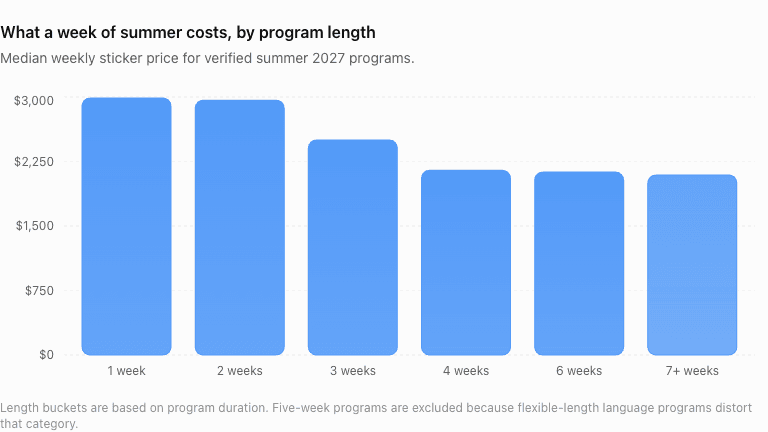
At three weeks, the median drops to about $2,500 per week. At four weeks, it's about $2,148. Six-week and full-summer programs remain close to $2,100 per week.
That doesn't mean a longer program is cheaper overall. A typical four-week program still costs about $8,695, compared with $5,798 for two weeks. You're spending more—but getting additional weeks at a lower weekly rate.
And this isn't just the result of comparing different kinds of programs. We looked separately at 121 organizations that offer similar programs with different lengths. From each organization's shortest option to its longest, the weekly rate fell by a median of 14%. Ninety-nine became cheaper per week, 14 stayed roughly flat and only eight became more expensive.
The takeaway: Staying longer generally gets you a modest weekly discount—but don't expect the cost per week to keep falling indefinitely.
Destination matters—but especially on shorter trips
International automatically means more expensive, right?
Not necessarily.
For programs lasting about two weeks, destination makes a noticeable difference. A continental U.S. program costs about $3,067 per week at the median. Europe comes in around $3,398 and Hawaii around $3,448. Latin America, meanwhile, is slightly below average.
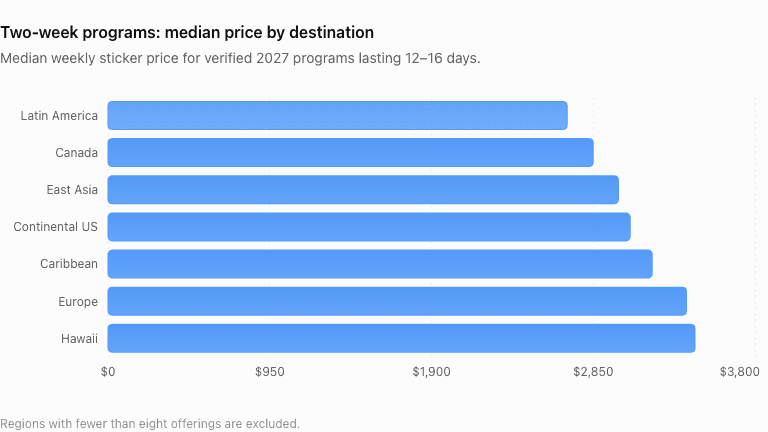
But stretch the program to around three weeks and the picture changes. Europe drops to about $2,533 per week, almost identical to the U.S. at $2,473. Latin America falls to $2,179.
Across all lengths, international programs have a somewhat higher weekly median—about $2,700 versus $2,604 domestically—and they're also longer: 21 days at the median versus 14. That helps explain why their total sticker price is substantially higher.
So where you go matters, but how long you go for can matter just as much.
What your teen studies matters less than you might expect
We also compared two-week programs by subject and program type.
Most cluster remarkably close together.
Wilderness programs come in around $2,998 per week. Business is $3,000. Tech & AI is $3,000. Marine programs are $3,101. Traditional camps are $2,950. Science & STEM is $2,910.
In other words, there isn't a huge "AI premium" or "marine biology premium" in the data.
There are some exceptions. Two-week residential arts programs are substantially less expensive, at about $2,242 per week, while pre-med comes in around $2,750.
A $6,000 program isn't necessarily more expensive than a $4,500 program
This may be the most important lesson from the data.
Comparing total prices can be misleading.
Imagine a $4,500 program lasting 10 days and a $6,000 program lasting three weeks. The second program costs substantially more, but it may offer considerably more time for every dollar spent.
That doesn't automatically make it better. A teen may prefer a short, intensive experience. A longer program means more time away from home. And families have to work within an actual summer schedule and budget.
But when comparing programs, we think it's useful to look at both total cost and cost per week.
Our data suggests roughly:
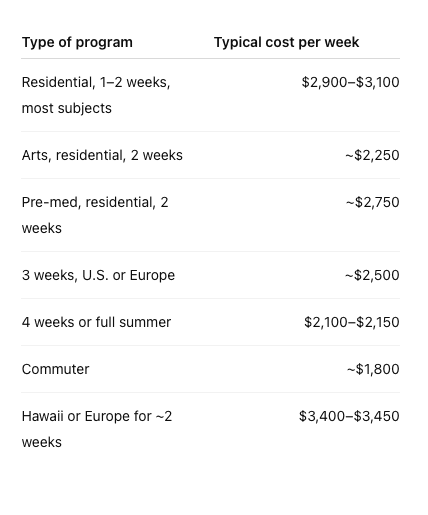
These are medians, not price recommendations or predictions for any individual program.
Don't forget what's not in the sticker price
This is where summer-program comparisons get messy.
Airfare is a major example. Among 591 international offerings in our analysis, 56 explicitly say flights cost extra. None explicitly say flights are included, while 410 don't say either way. That means a $6,000 international program and a $6,000 domestic residential program may not represent the same actual family expense.
There are other differences too: application fees, airport transfers, optional excursions, spending money, visas, supplies and equipment can all change the final cost.
And some prices aren't permanent. About 11% of the offerings in our analysis use an early-enrollment price, meaning the price families see later in the season may be higher.
So when comparing programs, don't ask only:
How much does it cost?
Also ask:
What does that price include?
So, how much should you expect to spend?
For many residential teen summer programs in 2027, roughly $3,000 per week is a reasonable starting point.
But that's only a starting point.
A longer program may bring the weekly cost closer to $2,100–$2,500. Short programs in places such as Hawaii and Europe tend to cost more per week. And international programs may require adding airfare to the advertised price.
The bigger lesson from our research is that price becomes much more useful when you compare similar experiences.
Instead of asking whether $7,000 is expensive for a summer program, ask:
How long is it? Where is it? What's included? And what do comparable programs cost?
That's the comparison that tells you what you're actually getting for the money. At Explore Summer, you can find and compare similar programs in one place, and we highlight additional expenses you might need to account for in our Hidden Details section.
About the data
This analysis uses programs verified for summer 2027 in the Explore Summer database. Programs without a usable price and $0 programs were excluded from the pricing medians. Weekly prices use the sticker-price midpoint divided by program length.
One useful robustness check: five large providers account for 39% of the offerings in the dataset. Removing all five leaves the overall median weekly price unchanged at $2,663. That suggests the headline number reflects the broader market rather than the pricing strategy of a handful of large companies.
Keep reading