
What We've Learned
What Does It Really Mean When Your Teen “Lives on Campus”?
We compared schedules, curfews, campus boundaries and residential rules across this year's programs. Living in a college dorm doesn't necessarily mean living like a college student.
“Experience college life.” “Live like a college student.” “Get a taste of campus life.” You'll see some version of these promises across pre-college summer programs. But they can describe very different experiences. At one program, a student might walk to class independently, choose where to eat lunch, and explore the surrounding neighborhood during free time. At another, students living in a university dorm follow a full-day schedule, leave campus only with staff, and have nightly room checks.
We looked beyond the program descriptions at schedules, residential rules, curfews, transportation policies, and supervision for the pre-college programs that publish those details. What we found: living on a college campus tells you surprisingly little about how independently a student will actually live.
Dorm life is usually more structured than “college experience” suggests.
A fixed schedule and close supervision are common. Across Summer Springboard’s high-school campuses, for instance, the daily schedule follows the same general pattern: breakfast at 8, class from 9 to noon, an afternoon activity or staff-led excursion, an evening workshop or club, and a dorm check at 10:30 p.m. A mentor lives on the hall.
Envision’s NYLF programs use a similar structure: morning sessions, afternoon workshops, and organized evening “Team Time,” with an advisor assigned to the group.
Summer Discovery’s UCLA program describes an exclusive residence hall. Both the UCLA and Yale programs describe activities every afternoon, evening, and weekend.
In these programs, living in a dorm doesn't necessarily translate into much unscheduled or unsupervised time.
A famous university campus doesn't necessarily mean more freedom.
Yale Young Global Scholars houses students in Yale residence halls, but its residential rules are among the most specific we found: students must stay within designated boundaries on foot, may leave campus only with staff or an approved adult, cannot use rideshares or public transportation, and must wear a name badge at all times. Suite check is at 10 p.m., with students in their own rooms after 11 p.m.
USC’s Cinematic Arts program for 16- and 17-year-olds uses similarly clear boundaries. There is one resident assistant for every seven students, nightly room checks, a 10 p.m. residence-hall curfew, and a 10:30 p.m. in-room time. Leaving campus requires a request 48 hours in advance and pickup by a parent or parent-designated adult.
Students still manage graded, college-level assignments. The academic work may be independent. The residential day is not.
Some programs really do offer something closer to college independence.
Tisch’s high-school residential program requires NYU housing and a full class schedule, but students can leave campus independently during free time, plan their meals around a 10-meal dining plan, and check into the residence at 11 p.m., with a 1 a.m. in-room time.
ArtsBridge lets students travel independently within a mapped campus-and-neighborhood boundary, with a buddy system encouraged rather than required and a 10 p.m. curfew for all ages. SOCAPA in New York starts with counselors walking students to restaurants for the first three days, then allows students to sign out for meals in small groups, though never alone.
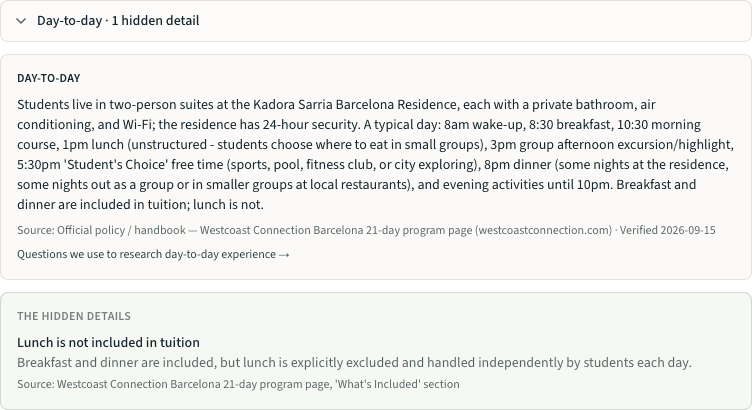
Westcoast Connection’s pre-college schedule includes an unstructured lunch and a “Student’s Choice” block. Adelphi tells families to expect a more self-directed day because the campus is open and mixed-age, and it describes the program as a chance to “preview college life.”
There isn't one model of a pre-college residential experience. Independence exists on a continuum.
Age matters more consistently than program length.
Younger students tend to be more closely supervised, even within the same program brands. Summer Springboard’s middle-school day ends with everyone back in the dorm by 8:30 p.m. and a mentor check at 9:30 p.m., compared with a 10:30 p.m. dorm check for high-school students.
Hotchkiss Summer Portals, for rising 7th and 8th graders, requires check-in at every meal and mandatory afternoon and evening activities, with dorm check at 8:30 p.m. Summer Discovery’s UCLA middle-school commuters cannot participate in evening or off-campus activities. Texas State’s junior residential math camp uses one counselor for every four students and explicitly describes the supervision as closer than in its high-school counterpart.
Program length does not necessarily line up with freedom.
We expected longer programs to look more like college life as students settled into a routine. That isn't what we found.
USC’s six-week program and Yale Young Global Scholars’ two-week program both keep older teens within defined boundaries and enforce relatively early curfews. Tisch’s four-week program, by contrast, is one of the programs we found that allows students to leave campus independently.
Duration alone isn't a good proxy for independence.
The brochure and the handbook answer different questions.
A program description might tell you about classes, campus life, excursions, and the promise of a “college experience.” It rarely tells you whether your teenager can walk to class alone, choose where to eat dinner, leave campus without an adult, or decide what to do with a free afternoon.
Those details tend to live somewhere else: in residential handbooks, FAQs, parent guides, packing instructions, and arrival materials. And they can fundamentally change what the daily experience looks like.
So before choosing a pre-college program, look beyond the campus and the course list. Ask what your teen's actual day will look like.
That's why Explore Summer goes beyond the program description. We research what daily life actually looks like and summarize what we find alongside each program, including supervision and independence, housing and meals, arrival procedures, additional expenses, and other details families may want to know before choosing a program.
Keep reading