
What We've Learned
Summer Camp Phone Policies: What Parents Should Know Before Their Teen Goes Away
We compared phone and family-contact policies across traditional camps, wilderness trips, teen travel programs, and pre-college programs. The rules range from phones disappearing on arrival to getting them back for a few hours every night, and some programs expect students to carry one.
A “no phones” policy sounds straightforward. Leave the phone at home, go to camp, and unplug.
The policies we found are considerably more varied.
Some camps collect phones on arrival and don't return them until the end of the session. Some wilderness and travel programs take them away for only part of the trip. A few programs return phones every evening. And at some pre-college programs, students are expected to have a phone with them.
Then there's a second question that's easy to overlook: if your teen doesn't have a phone, how will you communicate with them?
We looked through the policies and day-to-day details we've collected for this year's programs. What emerged isn't a simple divide between “phones allowed” and “phones banned.” It's a spectrum, and the type of program and age of the student matter.
Traditional camps: taking away the phone is often part of the experience
Among the 35 traditional camps for which we have detailed day-to-day notes, twelve mention phones, and every one of those restricts them. The other notes are silent on phones.
French Woods, Skylake Yosemite, Kennolyn, Camp Wah-Nee, and Camp Weequahic prohibit phones and other internet-connected devices. Catalina Sea Camp allows no phone contact at all and explicitly frames that as part of fostering independence rather than a consequence of poor connectivity.
Adirondack Camp arrives at a similar experience partly through geography: there is no cell reception and no electricity in the cabins, and the camp describes the experience as intentionally unplugged.
But “no phones” doesn't tell you what happens to the phone.
Camp Carolina collects phones from campers who fly to camp and stores them until closing day. Skylake warns that a device not surrendered on the first day may be held until the end of the calendar year. French Woods says a phone discovered after arrival may be donated to charity.
That's a considerable range of enforcement for policies that might all be summarized as “phone-free.”
Wilderness and teen travel programs use a different model
For wilderness and small-group travel programs, unplugging is often part of the trip rather than an absolute rule from arrival to departure.
Moondance, Overland, and Wilderness Adventures explicitly describe disconnecting from technology as a program value. Lasting Adventures operates in backcountry areas where cell service isn't available anyway.
Putney offers a particularly useful example of how the policy can change with age. Students make an arrival call home and then turn in their phones. On high-school programs, phones are generally returned around the halfway point—or after about seven days on shorter trips—with roughly weekly access after that. On middle-school programs, phones stay collected for the whole trip and come back only at roughly weekly check-ins and on the last day.
And this isn't exclusively a wilderness phenomenon. EXPLO's middle-school program at Wellesley is also designed as an unplugged experience.
Younger teens, at least in the programs we examined, tend to stay disconnected longer.
Some programs don't ban the phone. They ration it.
There's also a middle ground.
Rustic Pathways calls its policy “Trip Before Scroll.” Phones are held during daytime programming and returned after the day's final activity. Students can have them overnight, subject to quiet hours.
That's quite a different experience from a traditional camp that collects the phone until departure, even though both programs may describe themselves as limiting technology use.
For families comparing programs, it is worth asking a more specific question than “Are phones allowed?”
When does my teen actually have access to one?
No phone doesn't mean no contact with home
Once a program takes away the phone, it has to decide what replaces it. This is where we found some of the biggest differences.
Some camps replace texting with mail and email
Catalina gives parents five email credits each week, while campers communicate back through handwritten letters. There are no phone or video calls.
Wekeela accepts a daily parent email and sends parents scans of campers' handwritten responses. Island Lake distributes emails and letters after lunch and scans campers' replies. Walden prints parent emails and delivers them with the daily mail.
French Woods takes a more digital approach: each cabin has access to a computer for camper email, beginning 48 hours after arrival.
The child may be phone-free without the family being communication-free.
Phone calls may be scheduled, and surprisingly infrequent
At camps that permit calls, access is often tightly structured.
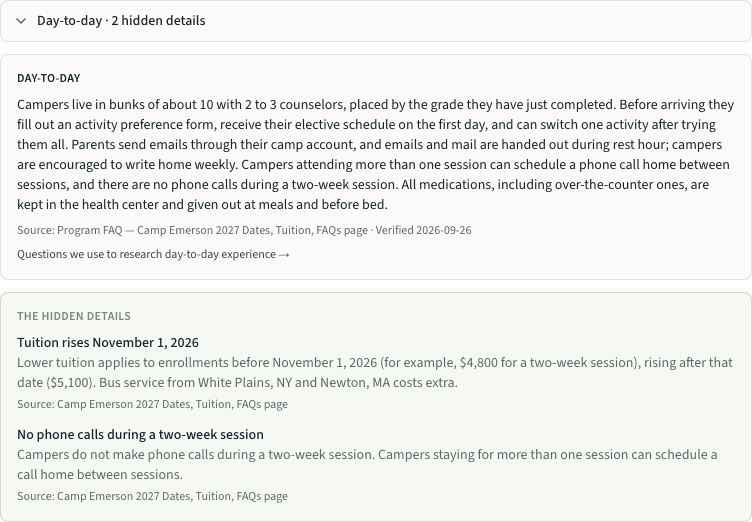
Wekeela allows one call every two weeks. Island Lake schedules two calls during a four-week session and one during a three-week session. Walden allows two calls per half-session. Robin Hood allows a 10-minute call when either the camper or parent has a birthday. Emerson has no calls during a two-week session, although students staying for consecutive sessions can call between them.
Watitoh uses another model: a director calls first-time families within 48 hours, and most campers subsequently speak with home every seven to ten days, supplemented by letters three times a week.
So “no personal phones” can describe family-contact policies ranging from regular correspondence to almost no direct conversation.
On wilderness trips, the staff may become the connection home
Backcountry and travel programs have another model: the student may be unreachable while the program itself remains in regular contact.
Lasting Adventures guides send a nightly satellite check-in to the office, operating under a “no news is good news” policy for families. Parents receive photos, a journal, and a trip recap afterward.
Putney leaders carry local phones and check in daily with the organization's Vermont headquarters. Bold Earth has students call home once they have met their group, then keeps families connected through blog posts and photos rather than regular student calls.
SeaTrek presents yet another version. Students reach port every few days and can make calls then. Personal phones work in the British Virgin Islands, but international charges make the program's calling-card option more practical.
In other words, “I can't reach my child” and “the program can't reach anyone” are two very different things.
Pre-college programs are largely a different category
The pre-college programs in our notes don't show the same pattern of collecting phones and replacing them with scheduled family communication.
When phone policies do appear, they can point in the opposite direction. Yale Young Global Scholars restricts phone use during lectures rather than banning possession. At AMHSI in Israel, every student is required to carry a phone so the campus can contact them.
But based on the policies we have seen, the highly managed phone-free system common at traditional camps does not appear to be the norm for pre-college programs.
Two questions matter more than “Are phones allowed?”
The clearest pattern in our research is that families really need to ask two separate questions:
- When will my teen have access to their phone? It might be never, after the first week, once a day, only while traveling, or throughout the program with restrictions on when it can be used.
- How will we communicate while they're away? That could mean handwritten letters, parent emails, scheduled calls, staff updates, photos and blogs, or very little direct contact at all.
For a first-time camper or a younger teenager, the second question may matter more than the first.
A program that collects phones for three weeks but provides regular letters and scheduled calls creates a very different family experience from one with the same phone rule and almost no contact. Likewise, a wilderness program where your teenager is unreachable but guides check in by satellite every night is different from simply disappearing off the grid.
The phone policy is one detail. It can change the whole experience.
It's easy to focus on the destination, activities, campus, or course when choosing a summer program. But practical policies—phones, communication, supervision, meals, transportation, spending money—often determine what daily life actually feels like once a student gets there.
That's why Explore Summer goes beyond the program description. We research the details that are often buried in FAQs, parent handbooks, packing lists, and arrival materials, and summarize what we find alongside each program.
So when you're comparing two programs that both look great in the brochure, you can also see what sending your teen there will actually mean.
Keep reading